
Unconfirmed bird; scan suggested Northern Mockingbird
By Avery Cole
Can this photo establish a mockingbird singing at night? Compare the visible bird with the missing species, sound, and local observation evidence.
Identification summary
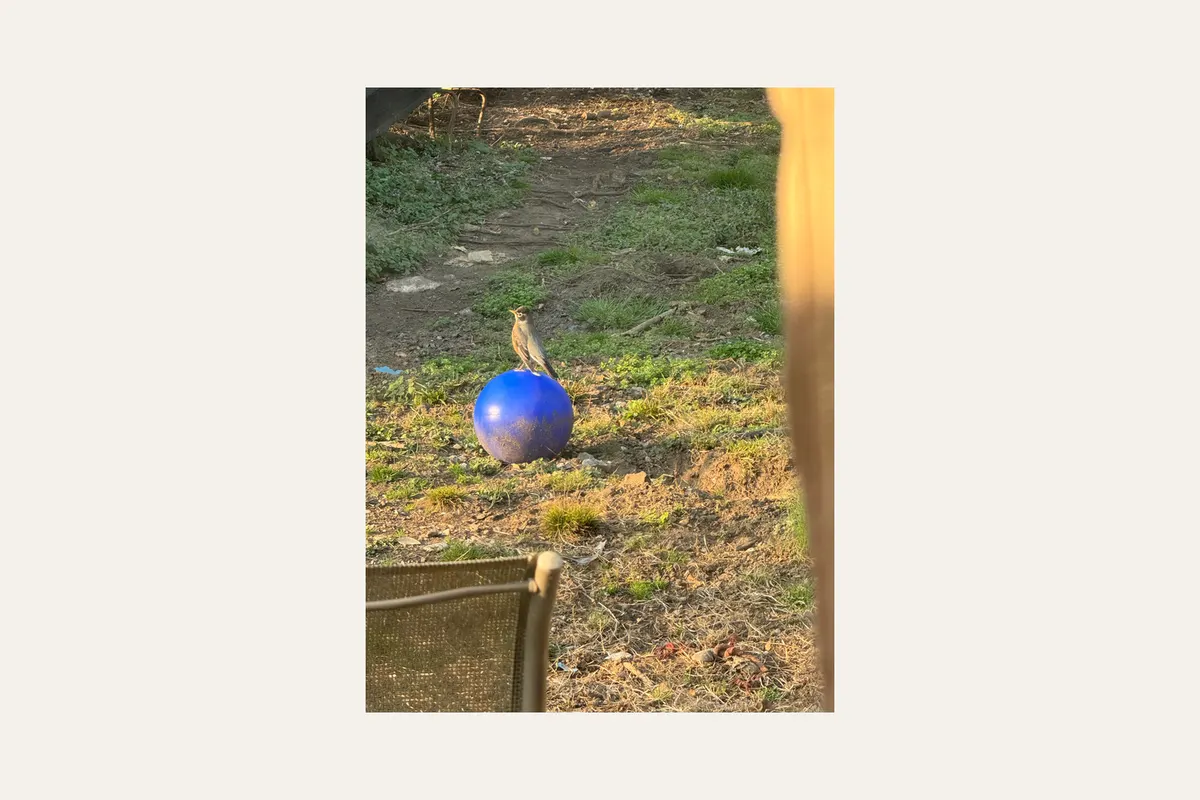
A mockingbird singing at night is a plausible observation, but this photograph does not document one. It shows a bird perched on a blue ball in a sunlit yard. The submitted scan suggested Northern Mockingbird; that suggestion is a starting hypothesis, not a confirmed identification.
The visible bird has a brown-gray back, a relatively dark head, and warm-colored underparts. Its body occupies only a small part of the photograph. Fine feather detail and diagnostic wing markings are not sufficiently clear here to confirm the suggested species. The warm breast color also warrants comparison with other yard birds rather than acceptance of the app label.
A still image contains no sound. It cannot establish which bird was singing, what the song sounded like, or whether a separate recording was made at night. No matching audio or local observation notes accompany this example. The light visible in the photograph should not be relabeled as a nighttime scene.
Evidence
| Visible setting | Sunlit yard; bird perched on a blue ball |
|---|---|
| Species | Unconfirmed |
| Audio evidence | Not supplied |
| Nighttime singing | Not established |
Historical context
For the species question, obtain a closer view of the head, breast, folded wing, and tail. Keep the whole bird in at least one frame so proportions remain visible. Compare the original image with reference photographs, including alternatives with warm-colored breasts. Enlarging a small crop may help viewing, but it cannot recover feather detail that was never recorded.
For the behavior question, a recording and contemporaneous notes are more useful than another distant photograph. Record the approximate local time, location, and whether you actually saw the bird producing the sound. A timestamp attached to an uploaded image is not necessarily the observation time and cannot establish local night without reliable context.
Listen to several phrases instead of identifying a bird from one short sound. Background birds, traffic, and insects can overlap a recording. If the singer is hidden, describe it as an unidentified sound until enough evidence supports a match. A photograph of a nearby bird does not by itself connect that individual to the recording.
Northern Mockingbirds do sing at night, particularly unmated males. That general behavior is described by the Cornell Lab of Ornithology (https://www.allaboutbirds.org/guide/Northern_mockingbird). It makes the original topic reasonable, but it does not validate the identification or behavior of the individual in this photograph.
The useful lesson from this example is to keep three conclusions separate: what the image visibly contains, what species is tentatively suggested, and what behavior was actually observed. A better photo could improve the species assessment; a recording could improve the sound assessment. Neither should be replaced by confidence in an initial app label.
What the submitted photograph establishes
A mockingbird singing at night is a plausible observation, but this photograph does not document one. It shows a bird perched on a blue ball in a sunlit yard. The submitted scan suggested Northern Mockingbird; that suggestion is a starting hypothesis, not a confirmed identification.
The visible bird has a brown-gray back, a relatively dark head, and warm-colored underparts. Its body occupies only a small part of the photograph. Fine feather detail and diagnostic wing markings are not sufficiently clear here to confirm the suggested species. The warm breast color also warrants comparison with other yard birds rather than acceptance of the app label.
A still image contains no sound. It cannot establish which bird was singing, what the song sounded like, or whether a separate recording was made at night. No matching audio or local observation notes accompany this example. The light visible in the photograph should not be relabeled as a nighttime scene.
Separate the species question from the song question
For the species question, obtain a closer view of the head, breast, folded wing, and tail. Keep the whole bird in at least one frame so proportions remain visible. Compare the original image with reference photographs, including alternatives with warm-colored breasts. Enlarging a small crop may help viewing, but it cannot recover feather detail that was never recorded.
For the behavior question, a recording and contemporaneous notes are more useful than another distant photograph. Record the approximate local time, location, and whether you actually saw the bird producing the sound. A timestamp attached to an uploaded image is not necessarily the observation time and cannot establish local night without reliable context.
Listen to several phrases instead of identifying a bird from one short sound. Background birds, traffic, and insects can overlap a recording. If the singer is hidden, describe it as an unidentified sound until enough evidence supports a match. A photograph of a nearby bird does not by itself connect that individual to the recording.
- Photo evidence: a perched bird in a visibly sunlit yard.
- Unresolved: species identification and the source of any song.
- Needed for this claim: a relevant recording and reliable observation context.
Why Northern Mockingbirds are associated with night song
Northern Mockingbirds do sing at night, particularly unmated males. That general behavior is described by the Cornell Lab of Ornithology (https://www.allaboutbirds.org/guide/Northern_mockingbird). It makes the original topic reasonable, but it does not validate the identification or behavior of the individual in this photograph.
The useful lesson from this example is to keep three conclusions separate: what the image visibly contains, what species is tentatively suggested, and what behavior was actually observed. A better photo could improve the species assessment; a recording could improve the sound assessment. Neither should be replaced by confidence in an initial app label.
Related guides
Check a bird identification suggestion against the evidence
Explore Featha’s bird-identification features (https://birdcallidentifier.app/) when investigating your observation. Treat a generated match as tentative and compare it with a field guide and, for a singing claim, the actual recording.
Take the next step →Frequently asked questions
Does this image confirm a Northern Mockingbird?
No. The bird is too small in the frame for a confident species match, and the warm-colored underparts call for comparison with alternatives.
Can the photograph prove nighttime singing?
No. It contains no audio and shows a sunlit scene. Nighttime song needs separate observation evidence.
Do mockingbirds actually sing at night?
Yes. Northern Mockingbirds can sing at night, especially unmated males, but that species-level behavior does not prove what this photographed bird was doing.