How To Identify Bird Sounds
How to Identify Bird Sounds: Listen, Record, Compare
Learn to identify bird sounds by rhythm, pitch, tone, and repetition. Record a clear sample, compare likely birds, and check uncertain matches carefully.
To identify bird sounds, focus on a single caller, capture several repetitions if possible, and compare the recording with reference sounds for likely local birds. You can begin even when the bird is hidden. A photograph is useful extra evidence when the singer is visible; it is not a prerequisite for listening or making a tentative identification.
Write down what you hear before searching for a species name. A note such as “three short whistles, a pause, then the same pattern again” is easier to compare than “a pretty song.” This description does not identify the bird by itself, but it gives you a repeatable feature to test against recordings.
Keep the original recording. If several birds overlap, note when your target sound occurs so you can return to the same moment. Treat the first suggestion as a candidate and compare it with what is actually audible.

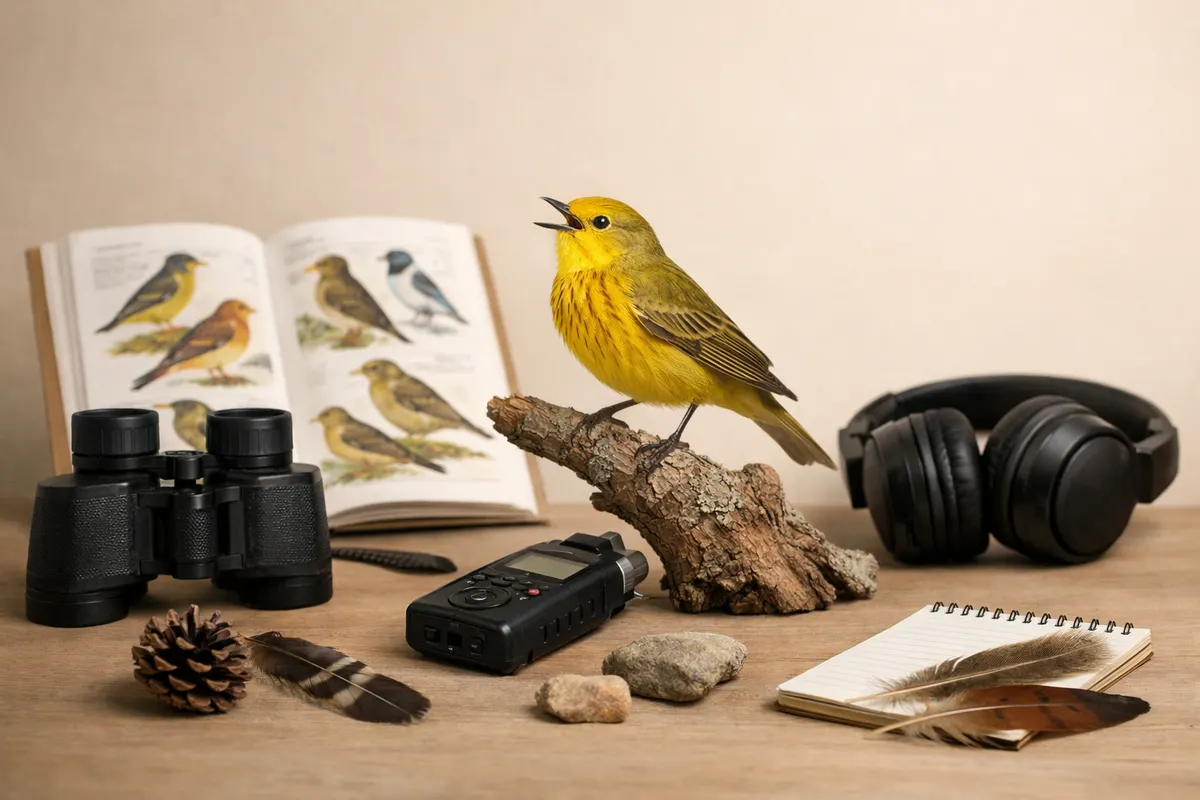
How identification works
Step 1
Snap a photo
Take a clear, well-lit photo of your item in the Bird Call Identifier: Featha app.
Step 2
Get an instant identification
The app reads the visible clues and returns the closest matches in seconds.
Step 3
Review the details
Compare the result with your photo, review any uncertainty, and check the suggested next steps.
Listen for rhythm, repetition, pitch, and tone
The Cornell Lab of Ornithology recommends separating bird songs into rhythm, repetition, pitch, and tone. Listen to each feature in turn instead of trying to memorize an entire chorus at once. Its sound examples illustrate these distinctions: https://www.allaboutbirds.org/news/parts-bird-song-rhythm-repetition-pitch-tone/.
For rhythm, notice the spacing and pace of notes. For repetition, listen for the return of the same syllable or phrase. For pitch, follow whether the sound stays level, rises, or falls. For tone, use a simple description such as clear, buzzy, rattling, or flutelike. These observations work together; no single one guarantees a species.
Make the comparison explicit. If your clip contains three evenly spaced whistles but the reference is an uninterrupted trill, explain that mismatch before accepting the candidate. A vaguely similar pitch should not outweigh a clearly different pattern.
- Describe a short phrase in your own words, including pauses.
- Mark the time in the recording where the clearest example occurs.
- Compare the beginning and end of the phrase, not just one note.
- List a feature that matches and a feature you still cannot resolve.
Record a useful sample and compare the result
Choose a position where you can hear the bird without approaching or disturbing it. Hold your phone or recorder steadily and avoid speaking over the target sound. Record enough to include repeated phrases when the bird provides them. A short clear sample is more useful than a long clip in which handling noise masks every note.
Record the general location, date, time, and habitat separately. Those notes help you choose sensible reference recordings. If you see the singer, note its appearance and behavior, but do not assume the most visible bird produced a sound that came from another direction.
Use the Bird Sound Identifier to examine a recording: https://birdcallidentifier.app/tools/bird-sound-identifier. Revisit the detected moments and listen for the proposed match yourself. A model score ranks suggestions from a recording; it is not a guarantee that the named species was present. If there is no clear match, keep the result unresolved and try a clearer recording later.
For a worked comparison of the kinds of sounds you may hear, read Bird Song Identification: Calls vs Songs and How to Compare What You Heard at https://birdcallidentifier.app/blog/bird-song-identification. Use the explanation to frame your listening, then compare actual recordings rather than relying on a written description alone.
Check what could have produced a misleading match
An overlapping chorus can combine notes from different birds into what sounds like one phrase. Return to the original clip and follow one repeating sound through several appearances. If a suggested species only resembles a fragment buried under another caller, record more evidence before treating it as identified.
Do not use a simple rule such as “steady sounds are insects” as a final identification. First establish which sound you are comparing, then test likely alternatives. Wind, mechanical noise, and other animals can make a recording difficult to interpret. An unresolved clip is a valid result.
A mnemonic can help you remember a familiar sound, but it is a memory aid rather than a transcript shared by every bird or every listener. Check the actual rhythm and notes when comparing a new recording. Practice with a small set of local birds and expand that set as your comparisons become more consistent.
If a visible bird appears to be calling, watch whether its movements coincide with the sound. Treat that as supporting context and retain the audio comparison. A nearby bird in a photograph does not establish which individual made the recording.
Frequently asked questions
Can I identify a bird by sound without seeing it?
Yes, you can compare a clear recording with known sounds even when the bird is hidden. Keep the conclusion tentative if the sample is short, noisy, or shared by several plausible species. A photo is optional supporting evidence.
How do I start learning bird calls?
Choose a small set of birds likely in your area. Listen to reference recordings, describe one memorable feature of each, and practice recognizing that feature in new recordings. Check your answer against the recording instead of relying only on a mnemonic.
How long should my recording be?
Capture enough clear sound to hear repeated phrases when possible. There is no duration that guarantees an identification. Keep the original clip and note the clearest moment; avoid adding noise by moving the recorder or speaking.
What should I do when an app suggests a surprising bird?
Listen to the proposed match and your clip again, checking the complete phrase and local context. A suggestion is a lead to investigate. Seek a second clear recording or an experienced listener’s review if the identification remains uncertain.
Related guides
Compare a recording with the Bird Sound Identifier
Try the recording-based tool at https://birdcallidentifier.app/tools/bird-sound-identifier, then listen back to the suggested moments. Keep uncertain results provisional and collect another clear sample when the evidence is incomplete.