Weird Bird Sounds
Weird Bird Sounds — What to Look For, With Real Examples
Learn which weird bird sounds details a photo can prove, which it cannot, and the follow-up checks worth doing before you rely on the answer.
Weird bird sounds are often startling, but a well-taken photo can cut through the mystery by showing plumage, posture, and location — the visual signals that narrow plausible callers. If you know the category of sound (alarm, mimic, mechanical-like), a single image plus context lets an identification tool prioritize species that make similar phrases.
When you pair an image with the sound type, the app can compare visible field marks (bill shape, throat pattern, tail length) against species known to produce the same rhythm or pitch. This is a fastest-first pass: it reduces the candidate list so you can decide whether to collect audio, observe behavior, or accept a likely match.
Expect uncertainty. Photos rarely prove who made a single call; instead they provide evidence to support or reject species that commonly produce those odd phrases. Note time of day, distance, and whether the bird was singing while facing you — those details change how a photo influences the likely ID.

How identification works
Step 1
Snap a photo
Take a clear, well-lit photo of your item in the Bird Call Identifier: Featha app.
Step 2
Get an instant identification
The app reads the visible clues and returns the closest matches in seconds.
Step 3
Review the details
Compare the result with your photo, review any uncertainty, and check the suggested next steps.
Visual clues to match weird bird sounds
Before you submit a photo, check a short list of signals that reliably change which species are possible. Size and silhouette immediately exclude many mimics: a large raptor or owl will not be confused with a tiny passerine even if both make odd noises.
Bill shape and gape tell you whether the caller uses a wide chorus beak for insect-chasing calls or a slender bill for whistles and tonal phrases. Throat patches, visible throat movement, and feather tufts can indicate syrinx morphology and help explain why a bird produces rattles, whistles, or mechanical-sounding notes.
Plumage pattern and distinctive marks (eyestripe, wingbars, tail banding) are the strongest single-photo signals that let an identification tool prefer one sound-producing species over another, especially when paired with habitat and posture.
Record the context in a short caption: perched height, neighboring trees, and repeated behavior (e.g., pecking a metal gutter). That short situational note often changes which species are realistic callers for the sound you heard.
- Size and silhouette — rule out species that are physically impossible callers.
- Bill and throat — look for a wide gape or throat feathering that matches rasping or alarm-like calls.
- Plumage field marks — eyestripes, tail bands, or wing patterns that link a photo to species known for that phrase shape.
- Posture and activity — whether the bird was gaping, bobbing, or facing the source of the sound.
- Perch and habitat — metal roofs, streetlights, and dense shrubs favor different mimic or mechanical-sounding callers.
- Time of day — nocturnal callers (owls) differ from daytime mimics and alarm-callers.
What a weird-bird-sounds identification returns
An identification result for weird bird sounds focuses on a short, evidence-driven package: the most likely species, confidence level, and the visible clues that led to each candidate. Results explain which field marks in your photo support or contradict each suggested match.
The report also highlights sound-relevant notes: typical phrase shape (e.g., repeated metallic clicks or a rising whistle), typical rhythm or repetition, and common contexts where that species produces the phrase. Where helpful, it points to species known to mimic mechanical noises or human-made sounds.
Because photos have limits, results include recommended next checks: a short list of behaviors to observe, whether an audio recording is likely to change the conclusion, and when a second photo from a different angle would increase confidence. For alarm-style sounds you can consult comparative guidance like Bird Alarm Calls vs Contact Calls: What Common Sounds Might Mean for patterns and interpretation.
- Top species match with a plain-language confidence estimate and the visible field marks that matter.
- Sound-shape notes: how the result matches the call's rhythm, pitch range, and repetition.
- Side-by-side lookalikes the photo could be confused with and which marks to photograph next.
- Explicit recording limitations and suggested follow-ups to raise or lower confidence.
Species often confused with unusual calls
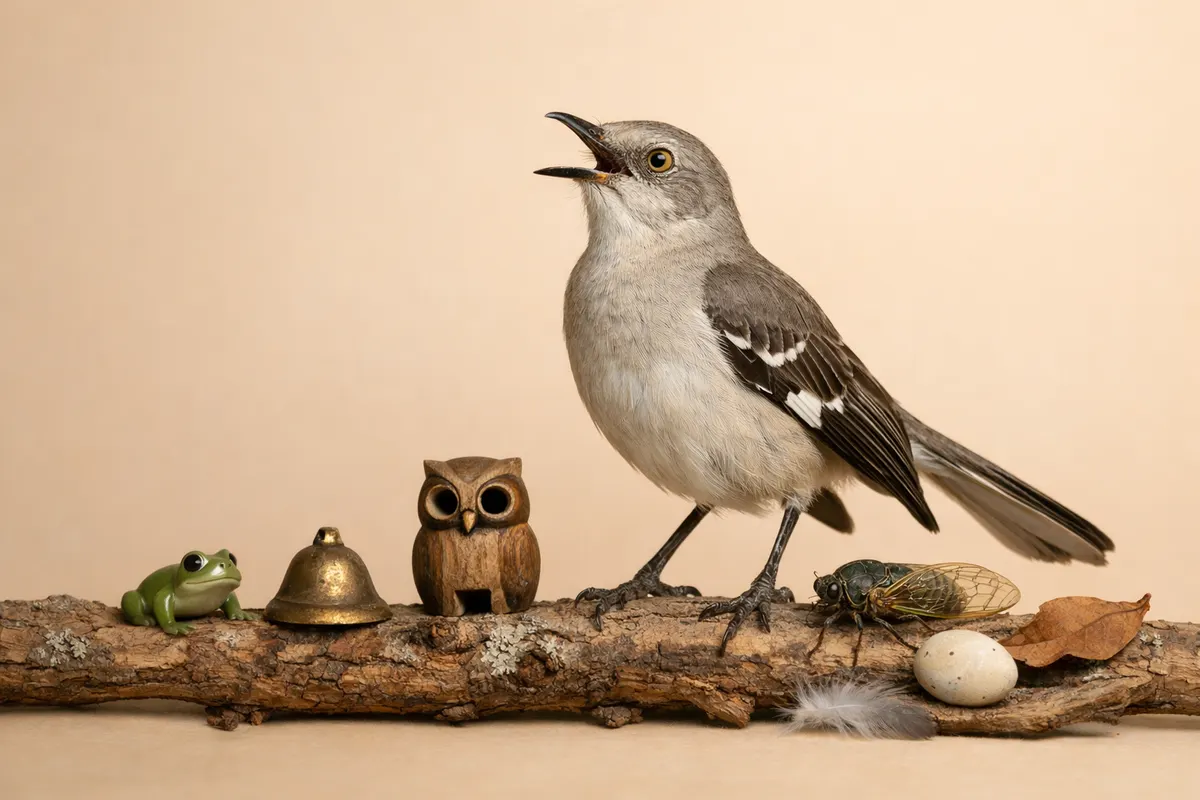
Mimics and noisy generalists are the most common culprits: Northern Mockingbirds and starlings can imitate alarms, phones, and other mechanical sounds, while small passerines may produce high, whistle-like notes that resemble electronic tones. A clear photo of bill shape and head pattern usually separates a mimic from a lookalike.
Owls and large nocturnal birds produce low, echoing hoots and unusual squeals that people sometimes describe as spaceship or R2D2 noises; a night-time photo showing facial disk, ear tufts, or eye color helps confirm or reject an owl ID. See the Great Horned Owl and Barred Owl pages for examples of distinctive visual field marks tied to their calls.
- Northern Mockingbird vs small thrushes — mockingbirds lack strong wingbars and often perch exposed while mimicking.
- European Starling vs small blackbirds — starlings show short wings and speckled winter plumage in photos.
- Owls (e.g., great horned) vs small passerine squeaks — facial disk and ear tufts differentiate nocturnal callers.
Frequently asked questions
Which species makes a bird that sounds like car alarm when I hear it from my driveway at night?
A repeated, metallic alarm-like sequence heard at night can come from mimic species or from certain stressed songbirds. Northern Mockingbirds and starlings commonly imitate car-alarm sounds, but some owl vocalizations can also be misheard as mechanical. Use a photo showing size, bill, and posture plus the time and exact perch to narrow the list; if you can, note whether the phrase repeated evenly or varied — uniform repetition leans toward mimicry.
What should I look for if I think a bird that sounds like a whistle is singing near my feeder?
Whistle-like notes often come from warblers, finches, or some thrushes. Photograph the bird's head and bill length and capture any leg or tail markings — a thin, pointed bill and upright posture usually indicate a true whistle-producing passerine, while a broader bill and streaking suggest a different group. Combine the image with the whistle's shape (pure tone or warbled) to match the species more reliably.
How can I tell which bird sounds like phone ringing when the call is faint and intermittent?
Faint, bell-like or ringing notes are often mimicry by species such as mockingbirds or by certain kinglets and warblers with thin high notes. A close, well-lit photo that shows whether the bird was perched on metal, wires, or foliage helps: mockingbirds will often use exposed perches and mimic nearby mechanical sounds, while small insectivores prefer foliage and emit purer, simpler ringing notes. Recording the pattern and submitting the photo with a short caption improves the match.
I heard a bird that sounds like r2d2 in my backyard at dusk — what species should I consider?
Descriptions like 'r2d2' usually mean a sequence of electronic-sounding whistles, trills, or rapid chirps. Such complex mechanical-like phrases are sometimes produced by starlings, mockingbirds, or even noisy wrens. Night-time or dusk occurrences raise the possibility of owls with unusual territorial calls. A dusk photo showing facial structure, silhouette, and habitat is the best next step; avoid assuming a single photo proves the caller, but it will narrow likely species.
Related guides
Use Bird Call Identifier - Featha to test a likely match
After you collect a clear photo and note the visible clues above, try Bird Call Identifier - Featha to see which species best match both the picture and the sound type. The tool summarizes visible evidence, lists nearby lookalikes, and suggests simple next checks — use that combined result as a practical first pass before relying on a single image. Start here: https://birdcallidentifier.app/tools/bird-sound-identifier.