Bird Call Identification
Great Horned Owl: Identification, Habitat, and Real Examples
Identify great horned owl sounds with visible clues, habitat context, and practical checks to improve confidence before you rely on a single photo or recording.
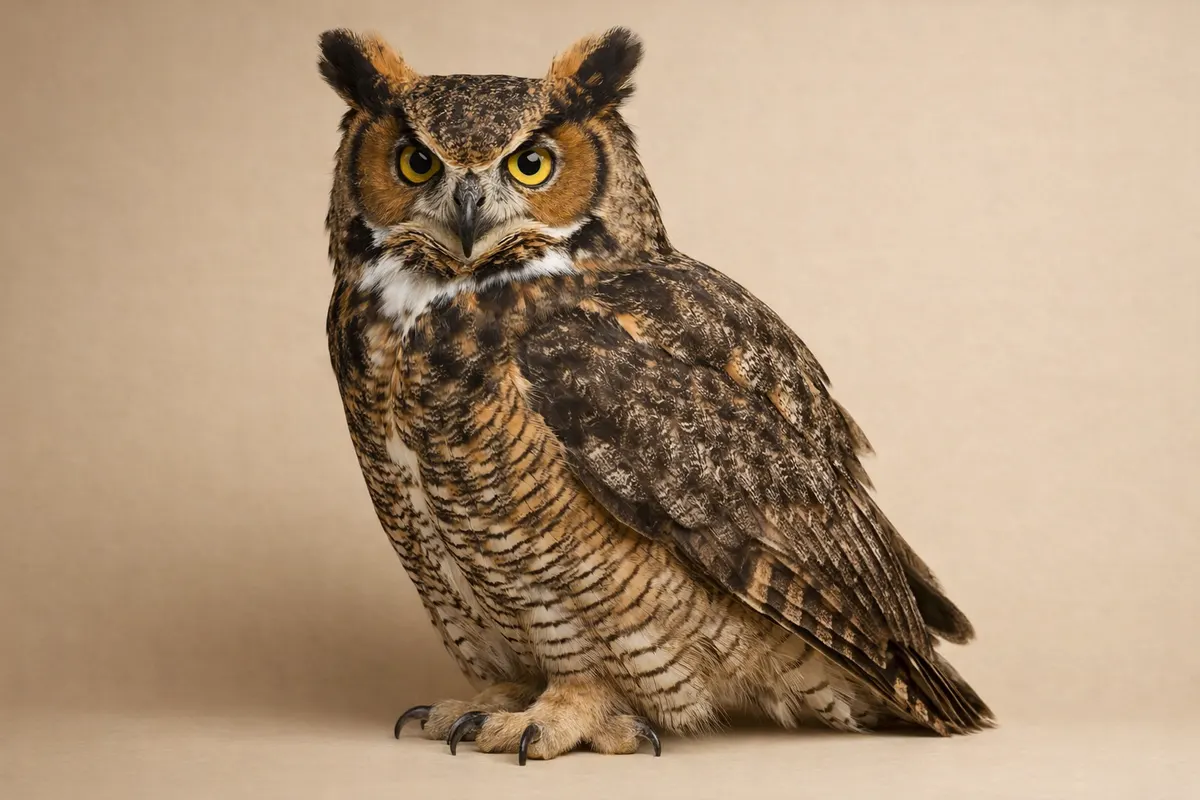
What a Great Horned Owl is and why its sound matters
The Great Horned Owl (Bubo virginianus) is a large, powerful owl of the true-owl family. Adults are notable for their prominent ear tufts, deep yellow eyes, heavily barred chest, and a rounded facial disc. Found across much of North and South America, this species occupies forests, suburbs, riparian corridors, and open country.
This owl is widely known for its low, resonant hoots; those vocalizations help listeners locate territory holders at night and during dawn. When people search for great horned owl sounds, they are often trying to match the characteristic pattern and tone that distinguish the species from other nocturnal birds.
Keep in mind that sound alone can be ambiguous. Wind, distance, and background species all change what you hear. Use audio clues together with visible features—size, ear tufts, facial pattern, and habitat—to reach a more reliable identification.
- Typical role of sound: territory hoots, duets, and contact calls rather than long melodic songs.
- Size context: adults 45–64 cm long with a heavy body and broad wings, so expect a deep, powerful hoot.
- Why recordings matter: rhythm and pitch offer initial clues, but photos confirm plumage and posture.
How can you identify a Great Horned Owl from photos and sound?
A photo gives strong, confirmable clues when it clearly shows the face, upper chest, and silhouette. Look for the short, pointed ear tufts set on a wide head, a rounded facial disc with darker rim, and bright yellow eyes. The chest is typically barred with broad horizontal bands on a pale background.
From an acoustic angle, great horned owl sounds are low-pitched and delivered as a series of spaced hoots — commonly rendered in field descriptions as a pattern like “hoo-HOO-hoo,” where one note is stronger and deeper. That rhythm and the deep fundamental frequency (often 200–400 Hz) are useful audio markers, but they cannot replace visible confirmation.
Combine clues: if you have a phone recording with a low, slow hoot series and a photo showing ear tufts and heavy barring, your confidence grows. If only a distant recording exists, note the habitat, time, and repetition pattern and treat the ID as provisional until visual evidence is available.
- Photo-check: ear tufts present, large yellow eyes, thick hooked bill, and heavy chest barring.
- Sound-check: low hoots with a strong mid-sequence accent and pauses of ~0.5–2 seconds between hoots.
- Behavioral hint: perched high on exposed branches at dusk or night, often near open hunting areas.
Key facts and quick measurements for the Great Horned Owl
Use this compact table as a quick field reference. Measurements and coloring can vary by region and subspecies, but the combination of size, ear tufts, and deep hoots is diagnostic in most habitats.
Read the rows to check which physical attributes you can confirm from a single photo and which typically require additional context like behavior or sound.
| Attribute | Typical value | Where to check |
|---|---|---|
| Length | 45–64 cm (18–25 in) | Measure in a photo against known perch size or nearby objects |
| Wingspan | 91–152 cm (36–60 in) | Silhouette in flight or open perch shots |
| Weight | 0.9–2.5 kg (2–5.5 lbs) | Not photo-checkable; infer from body thickness and wing size |
| Coloring | Mottled gray-brown with pale throat and barred chest | Face, chest, and upperwing patterns in close photos |
| Distinguishing feature | Short pointed ear tufts; deep low hoots | Head profile and audio recording if available |
| Active season | Year-round in most range; territorial calls any season | Timing and location notes to corroborate observations |
- Regional variation exists: western and eastern birds may show subtle plumage differences but share the same basic build and voice.
- Juveniles lack the strong chest barring of adults and may be misidentified without size or tuft cues.
- When photographing, aim for the head, chest, and wings to capture the most diagnostic patterns.
Where and when you'll hear or see a Great Horned Owl
Great Horned Owls are adaptable and occur in forests, woodlands, deserts with scattered trees, agricultural edges, and even city parks. They most often vocalize at night and during crepuscular hours, though daytime calling can occur during territorial disputes or nesting.
When trying to link a call to a photo, consider the landscape: an owl recorded over open fields and perching on poles or tall trees is consistent with great horned behavior. Suburban recordings are also common because these owls tolerate human-altered environments where prey like rabbits and rodents are plentiful.
Use timing and active-season clues to narrow possibilities. Territorial hoots are common in late fall and winter as pair bonds and territories are reinforced, while nesting activity generates more frequent calls in late winter and early spring.
| Region / Habitat | When you'll see/hear it | What you'll notice | Typical confidence cues |
|---|---|---|---|
| Mixed forests and woodlands | Night to dawn | Perched high, clear hoot series | Ear tufts and barred chest in photo |
| Suburban parks and riparian corridors | Dusk to night | Perches on poles or tall trees, hunting runs | Close-range photos with size context |
| Open country and edges | Night and crepuscular | Perch-and-pounce hunting; hoots carry far | Silhouette and deep voice support ID |
| Urban green spaces | Night and occasionally day | Short flights between trees, calling near lawns | Behavioral context plus photo increases confidence |
- Listen for great horned owl hooting at night in wooded edges and tall-perch sites; the phrase marks a common scenario for nighttime identifications.
- Dawn and dusk are prime windows for visual confirmation: look for large silhouette and ear tufts against the skyline.
- Urban and suburban parks: frequent hunting grounds, so don’t dismiss an owl just because it’s near development.
Commonly confused with
Several owls overlap in range or voice and can be mistaken for a Great Horned Owl. The most frequent photo confusions are Barred Owl, Long-eared Owl, and Great Gray Owl. Each has a few clear visual differences you can check in a single image.
Barred Owls are similar in size but lack ear tufts and have a rounder facial disc with dark eyes; their call is a series of rhythmic hoots that sound quite different from the deep, spaced hoots of a Great Horned. Long-eared Owls are slimmer with long, narrow ear tufts and streaked rather than broadly barred chest patterns; they often roost in dense foliage. Great Gray Owls are larger-bodied with a very large facial disc and no ear tufts, and their voice is softer and more rolling.
- Barred Owl — no ear tufts, round face, dark eyes; call is a rhythmic “Who cooks for you?” pattern.
- Long-eared Owl — slimmer body, long tufts, streaked belly; more often seen in dense woods or conifer roosts.
- Great Gray Owl — very large disc, no tufts, pale face and concentric patterning; voice lacks the Great Horned’s deep fundamentals.
Care, handling, and legal safety around Great Horned Owls
Great Horned Owls are wild birds protected in many places. In the United States and Canada they are covered by laws that prohibit taking, killing, or keeping without permits. Never attempt to capture, hold, or rehabilitate an owl yourself; handling can injure the bird and expose you to dangerous talons.
If you find an injured or grounded owl, keep people and pets away and contact a licensed wildlife rehabilitator or local authorities. Do not offer food or water directly; improper feeding can do harm. For concerns about nest sites near homes, consult local wildlife officials who can advise on legal and humane options.
Protective measures: secure poultry or small pets at night, use lights or motion deterrents sparingly if local officials recommend them, and avoid moving fledglings found on the ground unless they are clearly injured and you are directed by a rehabilitator.
- Legal note: many jurisdictions protect owls — check local wildlife laws before attempting intervention.
- Safety: large talons and beak can cause serious injury; maintain distance.
- If in doubt, photograph what you see, note location and time, and contact professionals for help.
Frequently asked questions
What does a great horned owl sound like when I hear hoots from my backyard at dusk?
A typical backyard recording of a Great Horned Owl will capture low, resonant hoots delivered in a spaced series, often with one stronger, deeper note in the sequence. Listeners often describe the pattern as a slow “hoo-HOO-hoo” rhythm with pauses of about 0.5–2 seconds between hoots. Wind, distance, or overlapping calls from other species can alter the perceived pitch and spacing, so pair the recording with a photo or habitat notes for stronger confidence.
How sure can I be identifying an owl from a phone recording alone?
A phone recording can provide valuable clues — pitch range, rhythm, and repetition pattern — but it rarely gives complete certainty by itself. Background noise, echo from buildings or valleys, and overlap with other species complicate audio-only IDs. Best practice is to treat an audio identification as provisional and seek a clear photo showing ear tufts, eye color, and chest pattern to confirm the species.
Can Great Horned Owls nest near homes and pose a danger to pets?
Great Horned Owls will nest in tall trees, on cliff ledges, and occasionally on human structures; they tolerate suburban settings if prey is available. They are powerful predators and can take small pets like rabbits or small cats if left unattended, especially at night. Use secure enclosures for outdoor poultry and supervise pets after dusk. If you find a nest near your home and are concerned, consult local wildlife authorities for guidance rather than attempting to remove or disturb the birds yourself.
When should I expect to hear more Great Horned Owl vocal activity during the year?
Vocal activity often increases in late fall and winter when pairs reinforce territories, and again in late winter and early spring during courtship and nesting. Nighttime calling is common year-round, but territorial hoots tend to be more frequent and pronounced during the breeding season. Local climate and food availability also shape calling behavior; colder winters may see different patterns as hunting behavior changes.
Related guides
Compare your photo and recording with Bird Call Identifier - Featha
Use Bird Call Identifier - Featha on your phone to compare clear photos and recordings against the visual and acoustic clues listed here. Start with the head and chest patterns in your photo, note the time and habitat, then open the app to run a comparison. Treat the app’s result as a helpful second opinion—follow up with habitat notes or a rehabilitator for high-stakes concerns.