Bird Call Identification
Barn Owl Sounds: How to Recognize and Verify Calls
Learn how to recognize barn owl sounds, what a typical call or screech means, and which photo and context clues you should check before relying on an ID.
Barn owl sounds: the basics and why they matter
Barn owl sounds are distinctive among owls because they rarely use the hoots many people expect. Instead, the species (Tyto alba and close relatives) is known for a long, hissing or screeching vocalization, short rasping calls, and quiet clicks during contact. Recognizing these patterns early helps you separate a likely barn owl from other nocturnal birds.
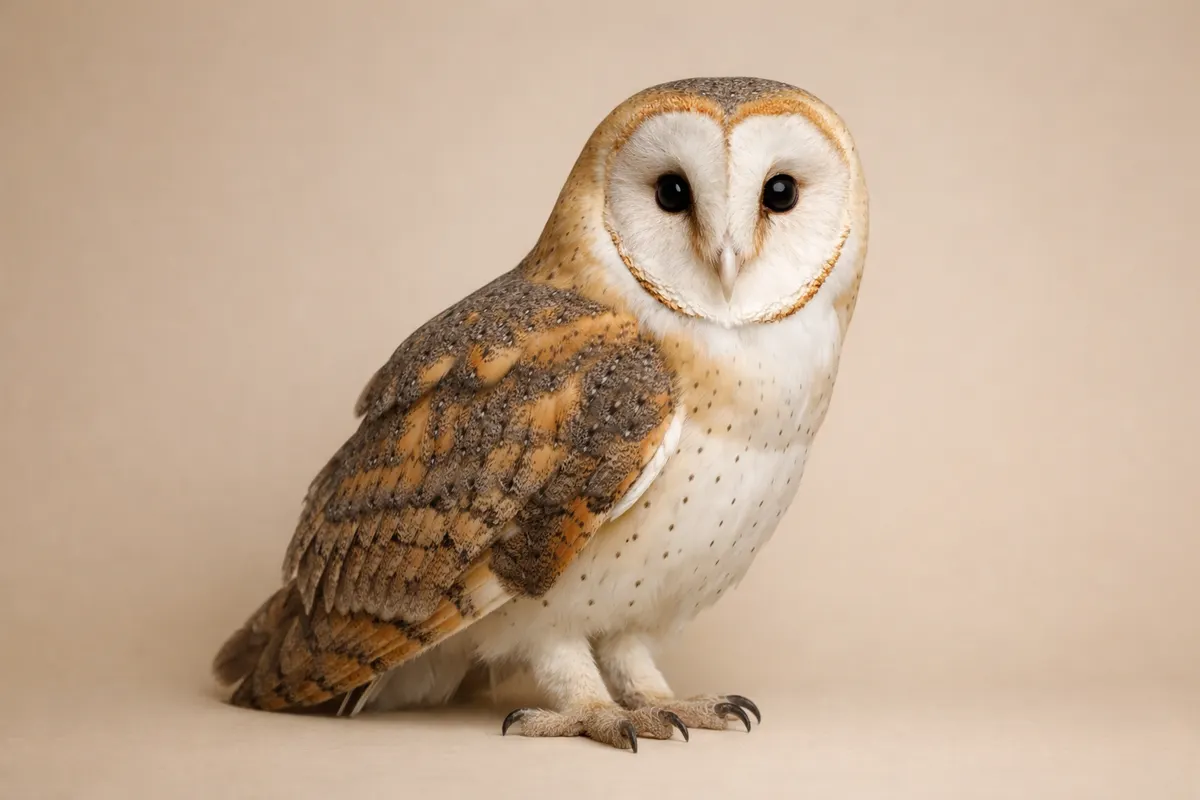
Adults are medium-sized owls with a heart-shaped facial disc, pale underparts, and mottled gray-brown upperparts; these visual clues combined with sound build confidence in an identification. Typical adult length is 33–39 cm with a wingspan around 80–95 cm, but local populations vary.
From a field-recording perspective, barn owl sounds provide practical clues: note the call’s duration, its pitch range (usually a single long note rather than a series of musical notes), and repetition pattern. These elements are useful when you have a short phone recording and a photo to compare.
- Most common vocalization: a prolonged, piercing screech or hiss rather than a two-note hoot.
- Facial disc and pale underside are key photo-checkable features to pair with any call.
- Calls tend to be monotone and sustained—listen for length and lack of musical trills.
How can you tell a barn owl by sound and photos?
When verifying barn owl sounds, use sound features alongside image clues. A single long scream or hiss that lasts a second or more, thin in timbre and lacking harmonic whistles, strongly suggests a barn owl. Compare that audio signature with visible traits: heart-shaped face, long legs, and pale chest visible in photos taken at close range.
Timing and context improve confidence. Barn owls hunt in low-light conditions and often call while flying low over open fields. If your recording shows a sustained, non-repeating scream and your photo shows the facial disc and pale underparts, the combined evidence is more persuasive than either alone.
Pay attention to recording quality: wind, distance, and background noise change perceived pitch and duration. If the recording is muffled, rely more on clear photo traits. Remember that a single photo or short recording rarely gives absolute certainty—treat identifications as probabilistic.
- Look for a long, monotone shriek rather than short, musical notes.
- Check for the heart-shaped facial disc and pale chest in photos to match the call.
- barn owl screech at night can carry a long distance in still air—note where you were relative to the sound.
- Compare call rhythm: barn owls often give single isolated screams rather than series of repeated notes.
Key facts
This compact table summarizes the barn owl’s most useful ID attributes for pairing photo and sound evidence. Use the values below to check whether your image and recording match expectations for the species in your region.
If a single value deviates (for example, size or plumage), treat the identification with caution and collect additional photos or a longer recording before concluding.
| Attribute | Typical value | Why it matters |
|---|---|---|
| Length | 33–39 cm | Helps rule out much larger owls like great horned owls |
| Wingspan | 80–95 cm | Useful when you have a flight photo |
| Plumage | Pale underside, mottled brown back | Pale chest contrasts with darker upperparts in photos |
| Facial disc | Distinctive heart shape | Primary visual cue; shows in many close photos |
| Call type | Long, drawn-out scream or hiss | The audio signature most often linked to barn owls |
- Match multiple attributes—size, face shape, and call timbre—to increase confidence.
- Local subspecies can shift plumage tones; photos of facial disc and underside are most consistent.
Where and when you’re most likely to hear barn owl sounds
Barn owls are global in temperate and tropical zones, preferring open habitats that support small mammals. They are most active at dusk and through the night, with peak hunting activity in the first few hours after sunset and before dawn. When trying to verify a sound, note the habitat, time, and what the bird was doing—these contextual clues are essential.
A sudden long scream from an open field or along hedgerows shortly after dusk is a common encounter scenario. In rural and semi-rural settings, barn owls may call from perches near barns, fence posts, or low trees while hunting. Urban sightings are less common but occur where suitable nesting and hunting habitat exist.
Season affects detectability: breeding adults may call more while defending territory or during courtship in spring, while juveniles make different contact notes. Seasonal context can shift your confidence in matching a sound to a barn owl.
| Region / Habitat | When you'll see/hear it | What you'll notice |
|---|---|---|
| Open farmland | Dusk to early night | Low flight, hunting over fields; long screams |
| Coastal marshes | Night and dawn | Silent hovering and occasional contact calls |
| Suburban edges | After sunset | Perched near barns, clipped flight silhouettes |
| Abandoned structures | Year-round (breeding season peak) | Nest calls, increased vocal activity in spring |
- Active times: primarily nocturnal, most detectable just after sunset and before dawn.
- Habitat notes: open farmland, marsh edges, and old buildings are common sites.
- barn owl screech at night often travels farther in still air—check distances when labeling your recording.
Species commonly confused with barn owl and how to separate them
Several owls and other nocturnal birds can be mistaken for barn owls, either by sight or sound. The two most frequent confusions at close range are Barred Owls (Strix varia) and Great Horned Owls (Bubo virginianus). Both differ visually and vocally in ways a photo or recording can reveal.
Barred Owls produce a series of rolling hoots and have a round facial disc with heavy barring across the chest—very different from the barn owl’s long scream and heart-shaped face. If your recording contains melodic hoots or a hooting phrase, lean away from a barn owl ID and check for barred owl characteristics; see our Barred Owl page for examples.
Great Horned Owls are larger, stockier, and have ear tufts; their deep, resonant hoots can be mistaken for an owl in the same vicinity but not for the thin screech typical of barn owls. When in doubt, compare photos and recordings against entries for Great Horned Owl and Barred Owl to identify distinguishing features.
- Barred Owl: series of hoots, round face, barred chest — not a barn owl (see Barred Owl: Identification, Habitat, and Real Examples).
- Great Horned Owl: deep, spaced hoots and ear tufts; much larger in flight silhouette (see Great Horned Owl: Identification, Habitat, and Real Examples).
- Small raptors and corvids can mimic calls briefly; check facial disc and flight pattern in photos.
Care, handling, and safety around barn owls
Barn owls are wild birds protected in many regions; do not attempt to handle or remove a bird unless instructed by a licensed wildlife rehabilitator. If you find an injured or grounded bird, secure the area, minimize handling, and contact local wildlife authorities for guidance.
When documenting a suspected barn owl, prioritize observer safety and the bird’s welfare: photograph from a distance with a zoom lens, avoid shining bright lights into nests or roosts, and never move chicks or adults unless they are obviously injured and a professional recommends removal.
Legal protections vary by country and state; if you plan to place nest boxes or run a local conservation project, check local wildlife regulations and, if needed, partner with a licensed group. Photographs and recordings are usually the best non-invasive documentation you can provide for monitoring or reporting.
- Never handle an apparently healthy wild bird; contact professionals for injured specimens.
- Use zoom or telephoto lenses to document facial disc and plumage without disturbing the bird.
- Respect local laws and protected species rules when interacting with nesting sites.
Frequently asked questions
What does a barn owl sound like when I hear a long scream near my property?
A barn owl’s most characteristic call is a long, drawn-out scream or hiss that can last a second or more and lacks the clear musical structure of many songbirds. If you hear a single sustained note, thin in timbre and often rising or falling slightly, that fits the barn owl profile. Combine that audio clue with a photo showing a heart-shaped facial disc and pale underside for stronger confidence.
Why did I hear a barn owl screech at night but see a different-shaped bird?
Sound can travel from far away and be distorted by wind or terrain, so the caller may not be the closest visible bird. Other species, like some raptors or corvids, can make brief harsh sounds that resemble a screech. Cross-check the call with the bird’s silhouette, facial features, and behavior in photos before assigning the sound to the bird you saw.
How can I tell a barn owl from a barred owl if I only have a recording?
Barred owl calls are typically rhythmic hoots in a multi-note pattern (often remembered as 'who cooks for you'), while barn owls produce a long, monotone scream or hiss. If your recording has repeated melodic hoots, it’s likely a Barred Owl. If it’s a single sustained shriek, a barn owl is a more probable match. Use any available photos to confirm visual differences like facial disc shape and chest patterning.
Can I rely on a single photo or sound recording to confirm a barn owl sighting?
No — a single, short recording or one photo rarely provides absolute certainty. Best practice is to combine multiple lines of evidence: clear photos showing facial disc and plumage, longer recordings showing call pattern, habitat context, and time of day. When possible, document multiple images and longer audio clips and note your location and conditions; these make identifications more reliable for field records or reporting.
Related guides
Compare your photo against Barn Owl clues with Featha
Use Bird Call Identifier - Featha on your device to compare your photo and any short recordings against the Barn Owl traits listed here. Start with visible checks—facial disc, pale underside, and flight silhouette—then add a recording to match call length and timbre. Treat the app’s result as a helpful first pass and gather multiple photos or longer audio if you need higher confidence; never assume certainty from a single image or clip.