Bird Call Identification
Barred Owl: Identification, Habitat, and Real Examples
Photo and audio clues to recognize a barred owl call, with clear visual markers, range and timing, lookalikes, and safe next steps for verification.
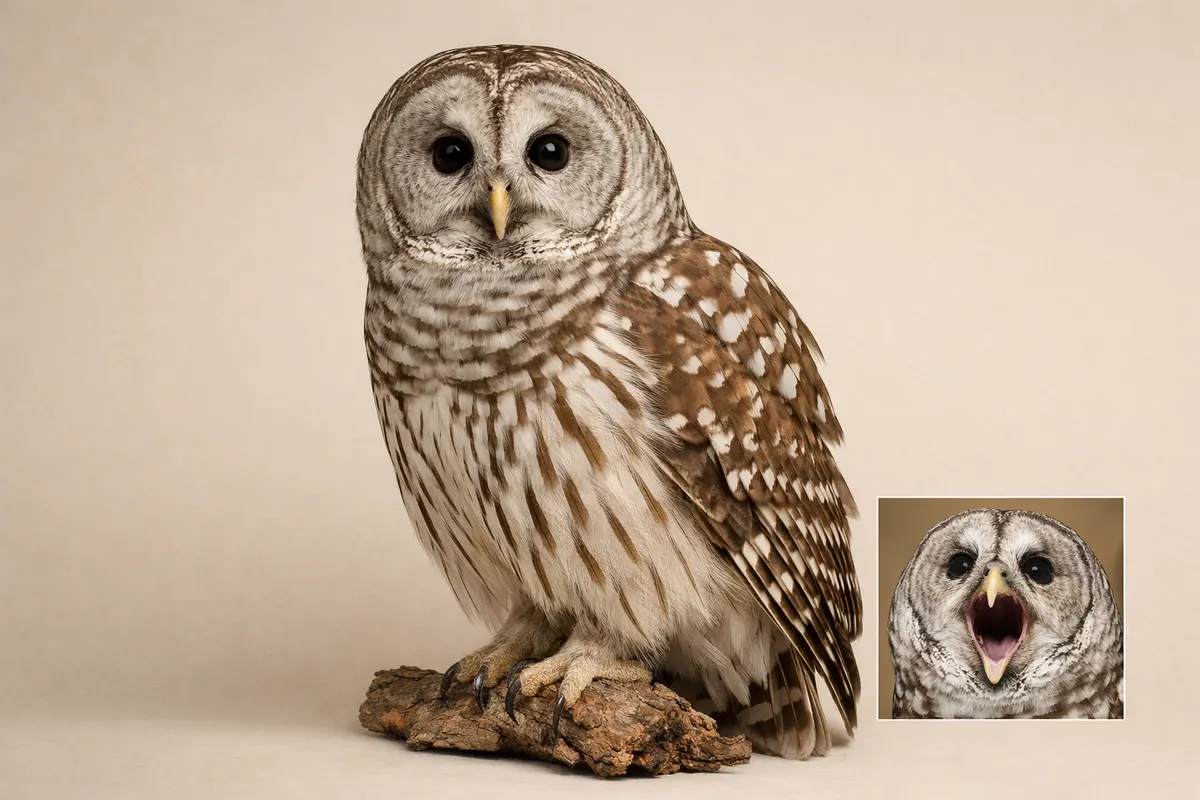
What a barred owl is and why its call stands out
The barred owl (Strix varia) is a medium-large, nocturnal owl native across much of eastern North America and parts of the Pacific Northwest. Birders and recorders most often recognize it by its distinctive, resonant hoots and by visual features that show up well in photos: round facial disk, dark eyes, and bold horizontal barring on the chest and vertical streaks on the belly.
When people talk about a barred owl call, they usually mean the species’ stereotyped hooting pattern: full, rich notes with a slightly nasal tone and a rhythm that can sound conversational from a distance. The call carries well through mature, mixed forests and across suburban green spaces, which is why this species is commonly heard near edges and wooded neighborhoods.
From the perspective of a field recorder or phone clip, the barred owl call is useful as an identification clue but not absolute proof. Acoustic pattern, habitat, and a clear photo together make a stronger case than sound alone — especially in areas where similar owls occur.
- Family and size: Strigidae (typical owls); roughly 16–25 inches in length, broad rounded head.
- Signature look: round facial disk, dark brown/black eyes (not yellow), barred chest, mottled back.
- Signature sound: full, spaced hoots with a conversational cadence that carry through dense woods.
How can you tell a barred owl from photos and recordings?
To confirm a barred owl from a photo, look for a combination of traits rather than a single mark. The facial disk is rounded with concentric feathering; the eyes are dark; the upperparts are mottled brown with fine barring; and the underparts show distinct horizontal brown bars across the chest and vertical streaks on the belly. These patterns are diagnostic in most lighting conditions.
When you only have a short recording, evaluate rhythm, pitch, and repetition. Barred owl hoots are typically spaced and have a full-bodied, slightly nasal pitch. Look for a long single-note phrase followed by several shorter notes or evenly spaced hoots that form a recognizable cadence; recordings with background noise can mask the pattern, so note habitat sounds and time of night when assessing confidence.
Use multiple photo angles when possible. A frontal head shot highlights the facial disk and eye color; a profile shows bill shape and feather pattern; a perched, full-body view best reveals the chest barring and relative length of the tail. If feathers look unusually worn or plumage seems atypical, that can indicate age or moult rather than a different species.
Compare empirical clues together: habitat, behavior (perching low near tree cavities or sitting still on horizontal branches), and vocal pattern. If field evidence is mixed, treat the result as probable rather than certain and seek additional visual records or a longer, higher-quality audio file.
- Facial disk: round and well-defined; eyes dark (not yellow).
- Plumage: horizontal bars on chest, vertical streaks on belly, mottled upperparts.
- Posture: broad-shouldered, rounded head with no ear tufts; often sits upright on horizontal branches.
- Audio cues: rich, spaced hoots with a nasal quality and steady rhythm.
- Recording checks: note background habitat noise, distance estimate, and time of night.
Key facts about the barred owl
Use the quick facts table below to check size, color, active season, and the single distinguishing field feature you can rely on most often in photos. These attributes summarize what photographers and recorders should weigh first when judging an uncertain sighting.
| Attribute | Typical | Notes |
|---|---|---|
| Length | 16–25 in (40–63 cm) | Variable by sex and region; looks large and stocky in photos. |
| Wingspan | 38–49 in (96–125 cm) | Broad wings; silhouette appears rounded in flight images. |
| Plumage / color | Brown and white with bold barring | Horizontal chest bars and vertical belly streaks distinguish it. |
| Eyes | Dark brown to almost black | Eye color helps separate it from yellow-eyed owls in photos. |
| Distinguishing feature | Barred chest and rounded facial disk | Most reliable single-photo ID clue when visible. |
barred owl sounds at night: when you'll hear them
Barred owl vocal activity peaks at dusk and through the first half of the night, though they will call at any hour in quiet, moonlit patches of forest. Expect more calling in late winter and early spring when pairs are establishing territories and during the nesting season. In suburban areas with mature trees, these owls often adapt and may call from yard-edge trees.
Regional presence matters. Barred owls are common across the eastern United States, throughout the Great Lakes region, and in parts of the Pacific Northwest where they have expanded. Their preferred habitat is mature, mixed hardwood and conifer woodlands with standing dead trees or cavities for nesting, and they are frequently heard along river corridors and wetland edges.
If you hear a single, resonant hoot sequence in a forested patch at night, note direction, relative distance, and whether you also see perching behavior. Photographs taken at twilight that show a perched bird on a horizontal limb and clearly reveal facial disk and chest barring are the best visual confirmation to pair with an audio clip.
For more on timing and how different owl calls compare at night, readers who are studying nocturnal vocalizations may find the site’s overview on owl timing useful for context.
| Region / Habitat | When you'll hear it | What you'll notice |
|---|---|---|
| Eastern deciduous forests | Dusk to early night, year-round with winter peaks | Clear hoots carrying through understory; perched low in trees |
| Urban / suburban parks | Dusk and early night, especially near mature trees | Calls from yard-edge trees; more tolerant of human presence |
| Riparian and wetland edges | Nighttime, often audible across water channels | Echoing hoots and occasional calls from exposed perches |
| Pacific Northwest mixed forests | Dusk–night, especially where range has expanded | Larger-sounding hoots in dense timber with deep resonance |
- Peak calling: dusk to early night, and increased activity late winter–spring.
- Common settings: mature mixed forests, riparian corridors, suburban woodlots.
- Visual pairing: twilight perched photos showing facial disk and chest bars improve ID confidence.
Species the barred owl is most often confused with
Barred owls are commonly mistaken for a few other large owls. The Great Horned Owl can be confused at distance because of similar size, but it has ear tufts, yellow eyes, and a deeper, more booming hoot. A clear photo of the head and eye color will usually separate the two immediately.
In parts of the West, the spotted owl is a lookalike in mottled plumage and similar habitat; spotted owls tend to have finer, darker streaking and different call patterns. Juvenile barred owls can sometimes resemble other young Strix owls until adult plumage fully develops.
Short-eared and long-eared owls have different silhouettes and flight styles; misidentifications usually arise from poor-quality distance shots. When in doubt, compare eye color, facial disk shape, chest barring pattern, and bill profile in the photo — those features are most diagnostic.
- Great Horned Owl — has ear tufts and yellow eyes; deeper hoots.
- Spotted Owl — finer streaking, different range and call structure.
- Juvenile owls — paler, less defined barring; confirm with multiple photos.
Care, safety, and legal limits when you find a barred owl
Barred owls are wild birds protected by laws in many jurisdictions. Never attempt to take a bird from the wild, keep it, or interfere with a nest. If you find an injured owl, contact a licensed wildlife rehabilitator or local wildlife authority rather than handling it yourself.
If you photograph or record barred owls, prioritize minimal disturbance: use a telephoto lens, avoid repeated approach to roosts, and do not play back calls near nests. Playback can stress birds, especially during breeding season, and can reduce your chances of a natural and verifiable interaction.
When sharing photos or recordings for help with identification, include context: time of day, habitat, distance estimate, and any behaviors observed. These details improve identification confidence without requiring intrusive actions.
- Do not handle live birds; call a licensed rehabilitator for injured wildlife.
- Avoid playback near nests and during breeding season to reduce stress.
- Provide contextual notes with photos or recordings to improve ID checks.
Frequently asked questions
What does who cooks for you owl mean when I hear it near my backyard at dusk?
The phrase who cooks for you owl is a human mnemonic some people use to remember the rhythmic pattern of a barred owl’s hoots, but the owl doesn’t actually say words. When you hear this pattern near your backyard at dusk it likely indicates a nearby barred owl calling from a perch; confirm with a photo showing the rounded facial disk and chest barring or a clearer recording to raise confidence.
How can I tell if a late-night hoot is a barred owl or another species?
Start with hoot structure: barred owl hoots are full, spaced, and slightly nasal in tone with a conversational cadence. Next, check habitat (mature woods and wetland edges favor barred owls) and any visible features in a photo—dark eyes, rounded face, and horizontal chest barring. Use multiple clues before concluding identity, since Great Horned and other owls can overlap in sound or range.
Can I identify barred owl sounds at night from a short phone recording?
You can often make a probable identification from a short recording if the hoot pattern is clear, background noise is limited, and you know the location and time. However, a single short clip can be ambiguous; pair the audio with habitat notes and a photo when possible, and treat the result as tentative unless multiple supporting clues align.
What should I do if I find an injured barred owl on the ground?
Do not attempt to care for or transport the bird yourself. Contact a licensed wildlife rehabilitator, local animal control, or a regional wildlife authority for instructions. Keep pets and people away from the bird, limit noise and disturbance, and provide the exact location and any visible injuries when you call for professional help.
Related guides
Compare your photo and recording with Bird Call Identifier - Featha
Use Bird Call Identifier - Featha to compare your photo against the barred owl clues on this page. The app helps you organize photos, attach time and location notes, and run a first-pass comparison between your images and field markers like facial disk shape and chest barring. Remember: the app is a useful first check but not a substitute for multiple confirming clues or expert verification; if you need help interpreting a recording or a poor-quality image, include habitat and time details when you share it in the app.