
Bird Call Identification
Blue Jay Call: Jeers, Hawk Mimicry, and ID Tips
Use photo clues and sound-shape checks to interpret a blue jay call, spot jeers, and judge likely hawk mimicry before confirming with a recording tool.
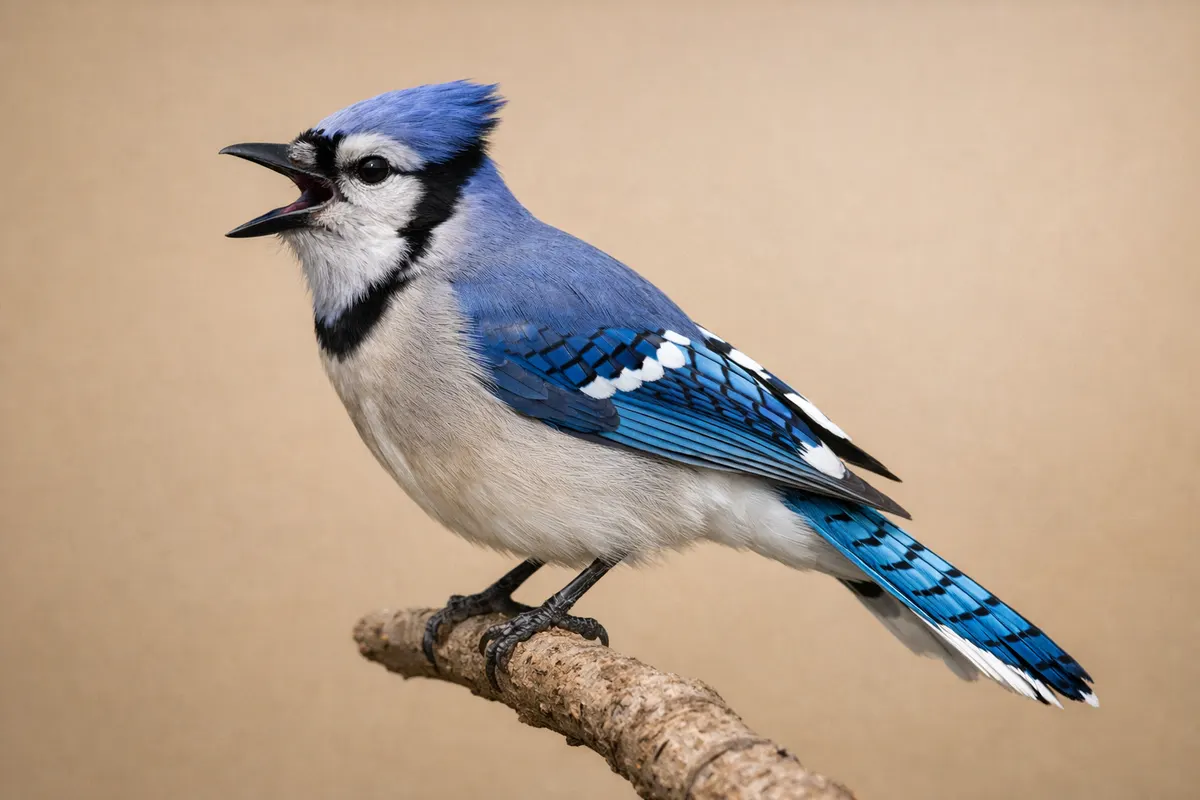
Blue Jay calls: species, range, and vocal role
The blue jay call refers to the short, harsh notes and longer mimicry phrases produced by Cyanocitta cristata, a common corvid in eastern and central North America. Blue jays are medium-sized songbirds (about 9–12 inches) in the Corvidae family; they are noisy, social, and vocally versatile, producing contact calls, alarm notes, and imitative phrases used in social signaling.
Blue jays are known for their sharp "jeer" or "jay" call — a raspy, abrupt sound often used to maintain contact with flockmates or to warn of predators. They can also produce whistles, gurgling sequences, and occasional accurate imitations of other birds and raptors; these mimicry events are less common but notable when they occur.
Interpreting a blue jay call depends on phrase shape (how notes are arranged), rhythm (spacing and repetition), and pitch range. Because blue jays mix short harsh calls with melodic or imitative phrases, listeners should combine sound analysis with visual checks — a single isolated recording without context is rarely definitive.
- Typical call type: short, harsh "jeer" notes used for contact and alarm.
- Mimicry: occasional accurate copies of hawks, other corvids, or songbirds, usually in short sequences.
- Vocal markers: abrupt attacks on notes, variable repetition rate, and a midrange pitch compared with hawk screams.
How can you tell a blue jay call from other birds?
Identify a blue jay call by listening for the jeer shape: a single, clipped, harsh syllable or a rapid series of clipped syllables with a percussive attack. The jeer is shorter and raspier than most hawk screams, and it often repeats in bouts rather than running long, undulating phrases.
Compare rhythm and repetition: blue jay notes are commonly evenly spaced or in short bursts (e.g., jeer–jeer–jeer), whereas many hawk vocalizations are long, wavering screams without the abrupt, staccato quality. If you have a recording, view its spectrogram to check for short, broadband spikes typical of corvid calls versus the continuous harmonics of a raptor scream.
Use visual context to confirm: a calling blue jay will usually be visible on open branches, feeder perches, or moving with other jays. If you hear a likely blue jay call but cannot see the bird, look for behavioral clues such as flock movement, alarm responses from other species, or repeated calling from a stationary perch.
- Jeer shape: short, raspy syllables with a hard attack.
- Rhythm: bursts or repeated short notes, not long descending screams.
- Spectrogram tip: look for short broadband spikes vs continuous harmonic bands.
Blue Jay call: key facts at a glance
This compact table lists attributes that matter when identifying a blue jay call: the bird's size and appearance, typical habitats, and the distinguishing vocal features you can expect to hear in the field or in a recording.
| Attribute | Blue Jay | Field notes |
|---|---|---|
| Size | 9–12 inches (23–30 cm) | Medium corvid; visible at feeders and treetops |
| Colouring | Blue crest, white face, black collar, barred wings | Distinctive plumage helps pair calls with visual ID |
| Typical habitat | Mixed woodlands, suburbs, parks | Common near oaks, feeders, and woodland edges |
| Active season/time | Year-round; vocal peaks in spring and early fall | Calls occur throughout the day; alarm calls spike at disturbance |
| Distinguishing vocal feature | Short, harsh jeers; occasional mimicry | Jeers: abrupt, percussive; mimetic phrases shorter than hawk screams |
Where and when you'll hear a blue jay call
Blue jays are widespread across eastern and central North America and are commonly encountered in suburban yards as well as mature woodlands. You are most likely to hear blue jay calls where there are oak stands, backyard feeders, or mixed hardwood edges that support both flocking and territorial behavior.
Timing matters: blue jays call at any hour but are most vocally active at dawn, in the late afternoon, and during sudden disturbances. Alarm calling will often concentrate when a predator appears or when a jay discovers a human-provided food source and alerts conspecifics.
When investigating a sound, combine the acoustic pattern with what you can see or photograph. A visible blue jay near a feeder or sitting in canopy cover while the same short, harsh notes repeat strongly increases confidence that the sound comes from a blue jay rather than a distant raptor or mimic.
| Region/Habitat | When You'll Hear It | What You'll Notice |
|---|---|---|
| Suburban yards & feeders | Daily, especially mornings | Short jeers near perches; visual jay presence likely |
| Woodland edge & oak stands | Seasonal peaks in spring/fall | Mixed calls, contact series, and occasional mimicry |
| Urban parks | Intermittent throughout day | Loud, repeated jeers; group interactions |
| Open fields (rare) | Occasional flyovers | Calls brief and isolated; visual confirmation harder |
- Best places to hear them: backyards with feeders, woodland edges, parks with mature trees.
- Peak times: early morning and late afternoon, plus quick alarm bursts when disturbed.
- Context clues: flock movement, looking-up behavior, or other birds responding to an alarm.
Calls commonly confused with a blue jay call
Several species produce sounds that can be mistaken for a blue jay call. Red-shouldered hawks and Cooper’s hawks sometimes vocalize near human habitats; their high-pitched screams or chattering can be confused with jay mimicry. However, hawk calls are typically longer, more plaintive, and lack the abrupt percussive attack of a jeer.
Other corvids and large songbirds such as grackles and crows can produce harsh notes or mimicry that overlap in frequency with blue jays. These species tend to produce lower, more sustained croaks or gurgles; blue jays' jeers stay higher in spectral energy and come with distinct staccato timing.
When assessing a questionable recording or field note, prioritize phrase shape and repeated structure. If visual evidence is available—feather pattern, size, or behavior—it can rule out lookalikes quickly; otherwise, a spectrogram comparison or a second, higher-quality recording is the safest next step.
- Hawks (e.g., red-shouldered): longer, wailing screams vs short jay jeers.
- Crows/grackles: lower, more guttural notes; different rhythm and social context.
- Imitators: jays can mimic hawks briefly—check repetition and abrupt attacks to separate them.
Care and safety when checking blue jay calls
Respect wildlife and legal limits: do not lure or trap birds for identification purposes. Recording or observing from a distance is the responsible approach; avoid playing predator or distress calls at loud volumes that could stress birds or disrupt breeding behavior.
Protect your recording gear and maintain clear sightlines: use binoculars and a directional microphone if possible, and avoid close approaches to nests. If you use a sound identifier tool to compare recordings, treat results as a probabilistic match rather than definitive proof and combine them with visual clues whenever possible.
- Never approach or handle wild birds for sound ID.
- Use long lenses and directional mics to reduce disturbance.
- Treat app-based matches as suggestions, not final verification.
Frequently asked questions
What does a blue jay sound like when it's calling at my feeder?
At a feeder a blue jay will often use its classic jeer: a short, harsh, raspy syllable repeated in bursts. These jeers are abrupt with a percussive attack and usually come in short series rather than long, wavering screams. You may also hear softer contact calls or rythmic rattles as jays move between perches. Combine the sound with a visual check of blue-and-white plumage and crest movement to confirm the source.
Is this a blue jay imitating a hawk near my yard?
Blue jay imitating a hawk does happen but is usually brief and context-dependent: jays will produce short, hawk-like phrases or whistles rather than the continuous, drawn-out scream of a true hawk. If the call is long, high-pitched, and sustained, a raptor is the more likely source; if it’s a short hawk-like fragment followed by typical jay jeers or seen with a visible jay, mimicry is plausible but not certain.
How can a spectrogram help me tell a blue jay call apart from a hawk?
A spectrogram shows time on one axis and frequency on the other; blue jay jeers typically appear as short, broadband spikes with abrupt onsets, while hawk screams show longer, continuous harmonic bands with a clear frequency contour. Comparing the shape and duration on a spectrogram helps separate percussive corvid calls from sustained raptor vocalizations, but background noise and recording quality can blur these distinctions.
What should I check visually if I only have a single photo and a recording?
Pair the audio with photo clues: look for blue jay field marks (blue crest, black collar, white face, and barred wings), perch behavior (staying at feeders or canopy edges), and group presence. Note lighting and distance in the photo—poor resolution can mislead. If the audio contains short, raspy jeers and the photo shows a jay in the area, the combined evidence strongly supports a blue jay call but do not assume absolute certainty from a single photo or clip.
Related guides
Compare your recording with the Bird Call Identifier tool
After you check visual cues and phrase shape, try comparing your clip with the live Bird Call Identifier - Featha sound tool to see likely matches and waveform details. Use the tool as a first-pass check alongside the tips above: it helps you compare rhythms and spectrogram shapes, but treat any match as a probabilistic suggestion and confirm with visual evidence when possible. Visit https://birdcallidentifier.app/tools/bird-sound-identifier to run a comparison.
Take the next step →